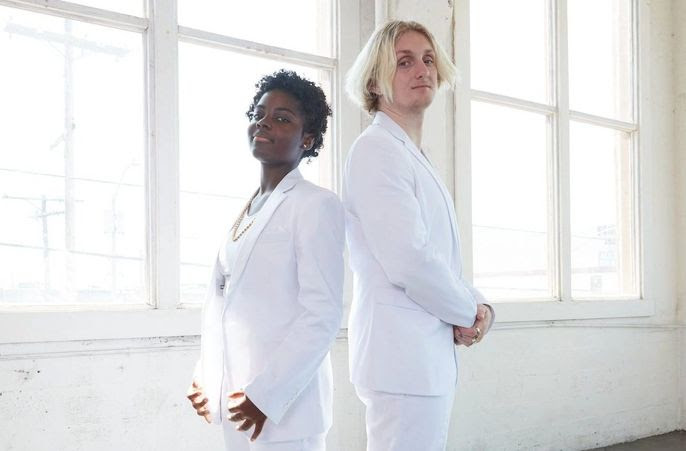
The music world is abuzz with the latest release from Hyperstisound, a duo composed of Hayyim and Andrea, whose debut album “Sound Memory of a Future That Has Not Happened Yet” is a thought-provoking exploration of nostalgia, technology, and the human experience. With a unique blend of academic rigor and pop sensibilities, Hyperstisound is redefining the boundaries of electronic music.
A Sense of Nostalgia for a Future That Never Existed
According to Hayyim, “There’s a feeling we all know but can’t quite put our finger on. You enter a place, hear a sound, see an image, and suddenly you’re overcome with a sense of longing for something you’ve never experienced.” This enigmatic feeling is the central theme of Hyperstisound’s debut album, which navigates the gray areas between memory, fiction, and technology.
Hayyim and Andrea’s musical journey began in 2007, within the academic world of contemporary concert music. They met while studying music composition, surrounded by complex scores, academic festivals, and technical jargon that can be daunting to outsiders. It was within this esoteric environment that their artistic partnership began to take shape.

Where Does This Music Come From?
To understand the Hyperstisound’s sound, it’s essential to delve into the technical roots of their music. The duo draws from two influential compositional traditions: spectralism and serialism. Spectralism, pioneered in France in the 1970s by Gérard Grisey and Tristan Murail, involves treating sound as a spectrum of frequencies, analyzing the timbre, and constructing music from it. Serialism, an older tradition, organizes musical elements (pitch, duration, dynamics) into pre-defined series, following a mathematical logic of composition.
These techniques are also employed by the IRCAM (Institut de Recherche et Coordination Acoustique/Musique) in Paris, a research center founded by Pierre Boulez. Hayyim and Andrea had direct contact with this world at an IRCAM congress, where they learned about cutting-edge software and technologies developed in-house for acoustic research. Much of the technical vocabulary in their debut album comes from this exposure.
Mais


From Academia to Pop
The question on everyone’s mind is: how does someone transition from the academic world of concert music to the realm of pop music? According to Hayyim, “The problem wasn’t the music itself, but the territory it occupied. The academic world is closely tied to academic festivals and conferences, but it’s still very focused on scientific knowledge.“ Andrea adds, “Sometimes it’s nice for people to listen to music without having to decipher it, with a drink in hand, enjoying the moment without needing to analyze it.“
A Process of Composition: Rigor and Spontaneity
Hyperstisound’s composition process is meticulous, almost laboratory-like. Each track begins with a specific fundamental frequency, from which they build the harmonic series that underpins the composition. They adhere to a strict schedule for recording, producing, and mixing, almost a protocol. Yet, the goal is to create an emotional, not analytical, experience.
This might seem like a contradiction: a controlled process yielding something spontaneous. Hayyim and Andrea have considered this. Andrea notes that before working on Hyperstisound, they were involved in freestyle music, creating intuitively. They wanted to try a more structured approach, which, they claim, has given them more time to live, explore, and return to the studio with fresh material.
The Name: Hyperstisound
The name Hyperstisound carries a rich cultural baggage. It’s a nod to the concept of hyperstition, coined in the 1990s by the Cybernetic Culture Research Unit (CCRU), a collective of theorists from the University of Warwick. Hyperstition refers to a fiction that becomes real through its circulation and acceptance, a loop between collective imagination and material reality.
Hayyim describes the name as “carrying a ton of cultural baggage.” He jokes that the name functions as a natural SEO for their artistic endeavors, allowing those who understand the reference to grasp the depth of their philosophy and cultural critique.
Nostalgia for a Future That Never Existed
One of the central themes of the album is this enigmatic feeling of nostalgia for a future that never existed. Hayyim recounts experiencing it for the first time while watching the TV series “The Langoliers,” based on a Stephen King story, without being able to explain the source of the sensation.
Andrea notes a curious coincidence: the film “Backrooms” recently brought a similar feeling to audiences, highlighting the universality of this experience.
Hyperstisound’s debut album is a thought-provoking exploration of the human experience, delving into the gray areas between memory, fiction, and technology. With their unique blend of academic rigor and pop sensibilities, they are redefining the boundaries of electronic music. As Hayyim and Andrea continue to push the limits of their art, one thing is certain: their music will continue to resonate with audiences, inviting them to explore the depths of their imagination.
The first single “sound memory of a future that has not happened yet” will be released on July 30th on all streaming platforms. The full album “our chosen beliefs about the future can retroactively form and shape our present realities” comes out on September 3rd.
Link to listen to the first single – https://orcd.co/soundmemory
Link to pre-save the album – https://orcd.co/hyperstisoundalbum
Info and social media – https://www.hyperstisound.art/biolink